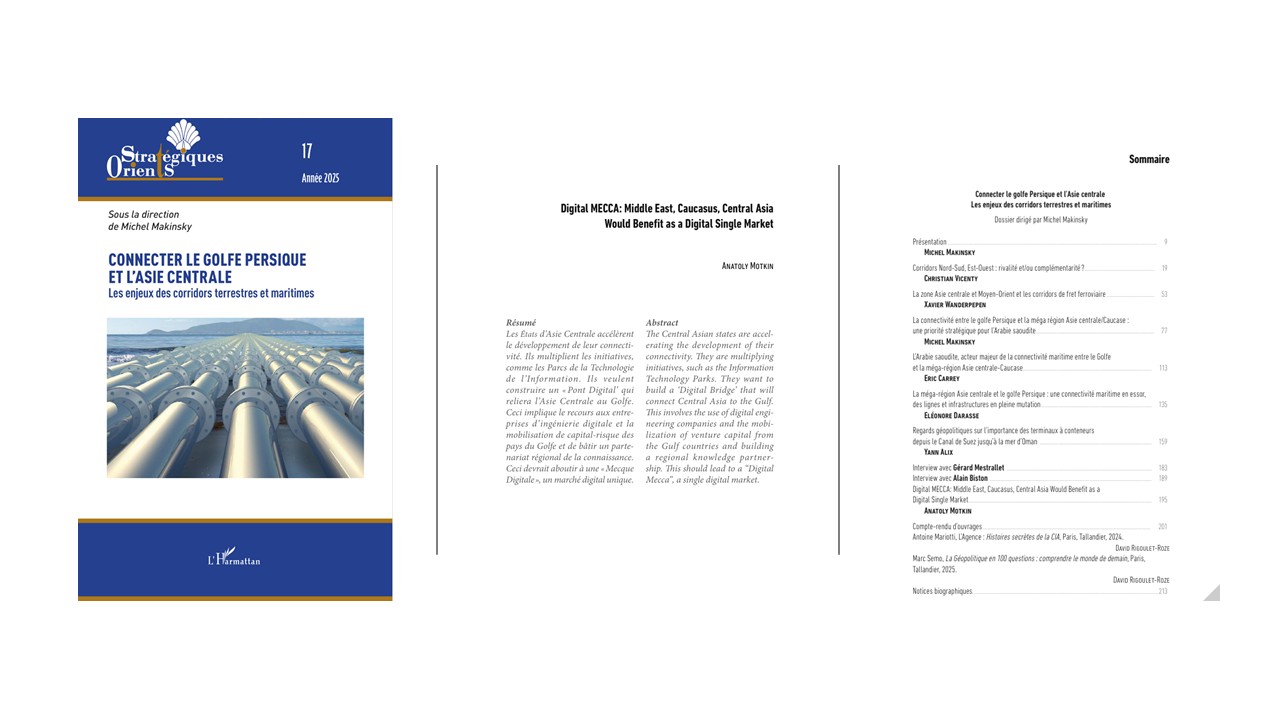
The top-tier French academic journal Stratégique Orienté, published by L’Harmattan Group, has released an op-ed by StrategEast President Anatoly Motkin titled “Digital MECCA: Middle East, Caucasus, Central Asia Would Benefit as a Digital Single Market.”
In this thought-provoking piece, Mr. Motkin lays out a bold vision for the creation of a unified digital market connecting the Gulf Cooperation Council (GCC) countries with Central Asia and the Caucasus — a region he refers to as the future “Digital MECCA.” The article comes at a critical time, as geopolitical and economic dynamics in Eurasia shift rapidly in the aftermath of Russia’s full-scale invasion of Ukraine.
StrategEast President argues that this war has accelerated the final dissolution of the Soviet legacy and forced many post-Soviet countries to reconsider their economic and strategic relationships with Russia. He asserts that, in many cases, ties with Moscow are now seen as more harmful than beneficial — both reputationally and financially — especially in emerging economies seeking sustainable growth and global integration.
Amid this turning point, Motkin proposes a new strategic partnership between the GCC and the countries of the Caucasus and Central Asia, focused not on natural resource extraction, but on a shared vision for a knowledge-based economy. He outlines three core pillars for building this “digital bridge”:
1. Digital services delivery – encouraging Gulf countries to tap into the robust software engineering and digital services expertise found in Central Asia and the Caucasus, where regional offices of international tech companies already serve top-tier global clients with high-quality, competitively priced solutions.
2. Venture capital investment – opening up the underfunded but rapidly growing startup ecosystem in Eurasia to Gulf venture capital. Motkin highlights the region’s strong pipeline of tech talent and innovation, which has been shaped by collaboration with Silicon Valley accelerators, as a promising destination for smart investment from the Gulf.
3. Regional knowledge partnership – establishing collaborative frameworks between global IT companies and Gulf governments to build local R&D centers, nurture talent, and accelerate the knowledge economy in both regions.
Mr. Motkin’s article emphasizes that the Gulf’s growing ambitions in the digital space align naturally with the capabilities and aspirations of Eurasia’s emerging tech hubs. With similar cultural values, overlapping time zones, and complementary assets, the Gulf-Central Eurasia partnership has the potential to become a new axis of digital transformation.
L’Harmattan, an independent French publishing house known for championing intellectual discourse and supporting Francophone authors, recognized the importance of this vision in the context of global realignments. By featuring this article, Stratégique Orienté reinforces the urgency of rethinking partnerships in the post-post-Soviet space and embracing a future driven by digital innovation and shared prosperity.