
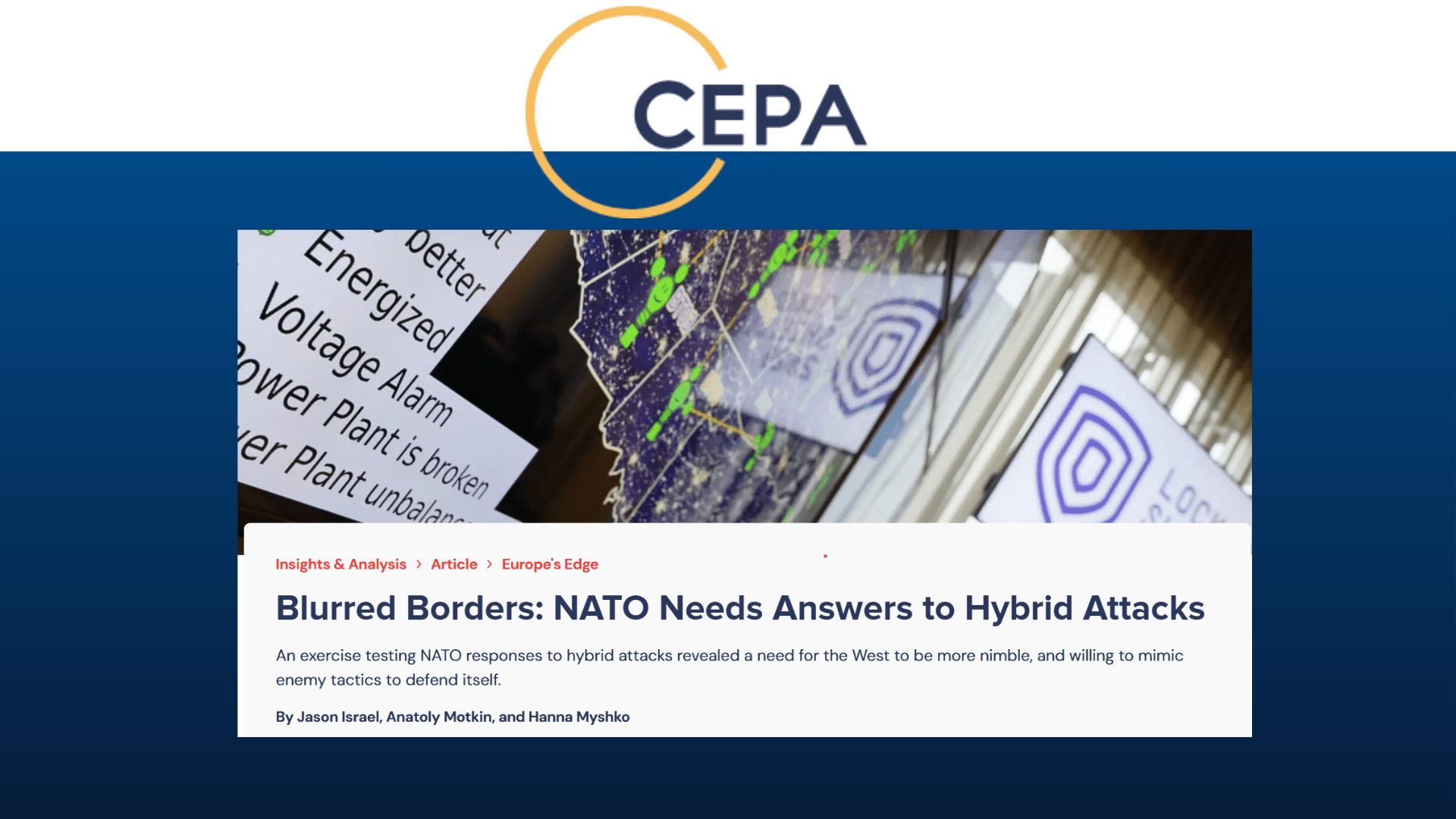
StrategEast announces the publication of a major analytical article developed in partnership with the Center for European Policy Analysis, based on the high-level tabletop wargaming exercise jointly convened by StrategEast and CEPA in February 2026.
The article, “Blurred Borders: NATO Needs Answers to Hybrid Attacks,” co-authored by Anatoly Motkin, President of StrategEast; Hanna Myshko, Regoinal Director at StrategEast; and Jason Israel, Auterion Senior Fellow for the Defense Technology Initiative at the Center for European Policy Analysis, examines how NATO must adapt to increasingly sophisticated hybrid threats, particularly in electronic warfare, gray zone escalation, and strategic ambiguity.
The exercise brought together senior experts from the United States and Ukraine to simulate scenarios involving electronic warfare spillover into NATO territory. Participants were challenged to assess strategic, diplomatic, intelligence, and technical response options in situations where disruption could rapidly escalate from infrastructure interference to civilian casualties.
A central finding was that NATO’s current decision-making structures remain vulnerable to ambiguity, delayed attribution, and political hesitation. As hybrid attacks evolve from disruption to potential loss of life, alliance members face growing uncertainty over when collective defense mechanisms should be activated and how to respond effectively below the threshold of open conflict.
The exercise highlighted that while adversaries can operate aggressively in the gray zone with plausible deniability, NATO remains constrained by legal thresholds, consensus-driven processes, and risk aversion. This strategic imbalance allows hostile actors to exploit the space between peace and war faster than the alliance can react.
Participants emphasized the need for NATO to expand its toolkit of sub-threshold responses, including selective intelligence declassification, covert support mechanisms, stronger deterrence measures, and more agile political coordination. Equally critical was the ability to rapidly shape public narratives through credible attribution, which remains essential for sustaining political unity and deterring future aggression.
The publication also underscores Ukraine’s unique value as a frontline innovator in modern warfare. Ukraine’s battlefield-driven expertise in electronic warfare, countermeasures, autonomous systems, and rapid defense adaptation offers NATO practical operational lessons that remain underutilized within broader alliance planning.
The joint analysis concludes that NATO must invest more seriously in gray-zone resilience, integrate Ukrainian defense innovation more deeply, and develop greater political willingness to act decisively under conditions of uncertainty. Without faster adaptation, the alliance risks remaining structurally reactive in a security environment increasingly defined by blurred boundaries and persistent hybrid pressure.
Through this collaboration with CEPA, StrategEast continues to strengthen its position as a leading contributor to strategic policy discussions at the intersection of security, governance, digital resilience, and geopolitical transformation across Eurasia.