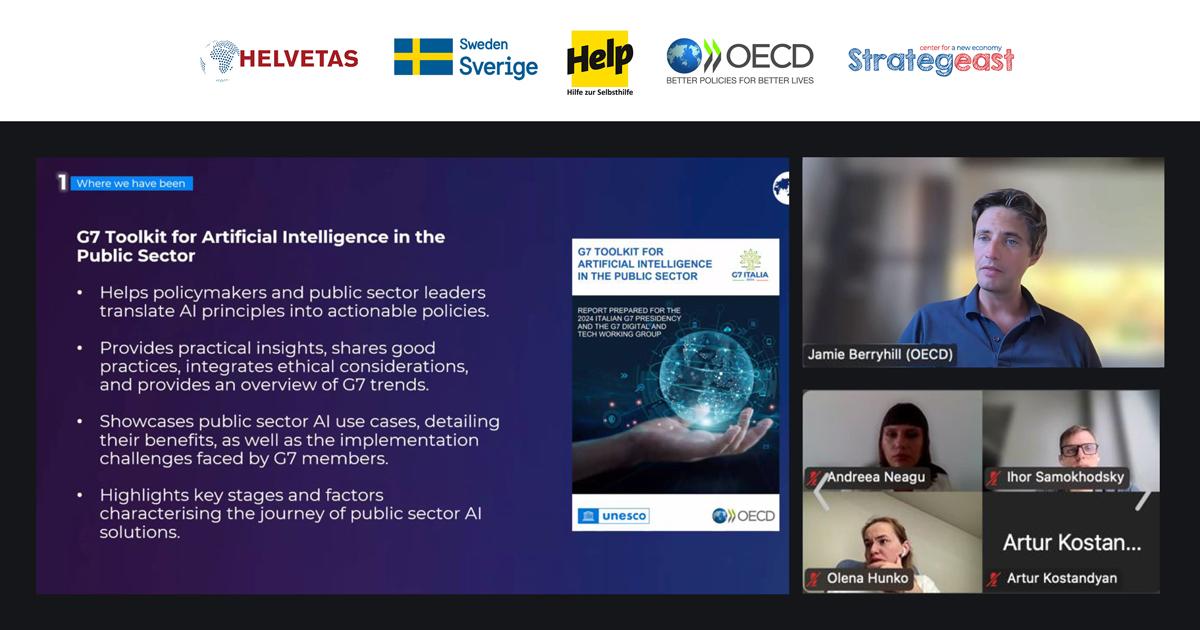
On June 17, StrategEast, in collaboration with the Organisation for Economic Co-operation and Development (OECD), hosted a high-level regional workshop titled “From Policy to Practice: Making AI Work in the Public Sector.” The event brought together public officials and digital transformation teams from Armenia, Georgia, Moldova, and Ukraine to explore how artificial intelligence can be applied effectively and responsibly in public governance.
Led by Jamie Berryhill and Ricardo Zapata, AI Policy Analysts at the OECD Public Governance Directorate, the workshop offered an in-depth look into global best practices, practical use cases, and key challenges in adopting AI across government functions. The discussions were based on preliminary findings from an upcoming OECD report analyzing over 200 AI use cases across 11 government functions. These insights revealed how AI is already contributing to improvements in public service delivery, civic participation, justice administration, and decision-making. Participants also examined the common risks associated with AI, including data inaccuracy, operational failures, exclusion risks, and public mistrust.
Throughout the workshop, the OECD team introduced a comprehensive framework for trustworthy AI in the public sector, built on three core pillars: enablers, guardrails, and engagement. Enablers such as adequate skills, governance structures, and digital infrastructure create the conditions for responsible innovation. Guardrails ensure ethical use through laws, standards, and risk monitoring, while engagement promotes inclusion of civic voices in the development and use of AI tools. The speakers also highlighted the need for governments to continuously refine their AI policies in response to fast-evolving technologies and to adopt transparent practices, such as Canada’s public algorithmic impact assessments.
Participants discussed various approaches to AI implementation, including open-source models, custom government-developed tools, and public-private partnerships. The conversation addressed challenges in scaling pilot projects, ensuring data protection, managing procurement, and demonstrating return on investment for AI in government. Specific examples included localized AI solutions in justice and legal services, civic engagement platforms, and tax administration tools.
As a follow-up to the session, the OECD committed to sharing the forthcoming report, presentation materials, and additional resources with participants. Future work will include continued research on scaling AI in government and exploring privacy-enhancing technologies as part of the policy toolkit. Participants were also encouraged to review the OECD AI Principles and consider formal adoption where relevant, as well as to maintain direct dialogue with the OECD team for further support.
This event was part of the broader AI Policy Dialogue Initiative, implemented by StrategEast in partnership with RECONOMY, an inclusive and green economic development program of the Swedish International Development Cooperation Agency (Sida), implemented by HELVETAS Swiss Intercooperation in partnership with Help – Hilfe zur Selbsthilfe. The initiative aims to strengthen multistakeholder collaboration and foster meaningful dialogue to develop responsible and inclusive AI strategies and governance across Armenia, Georgia, Moldova, and Ukraine.