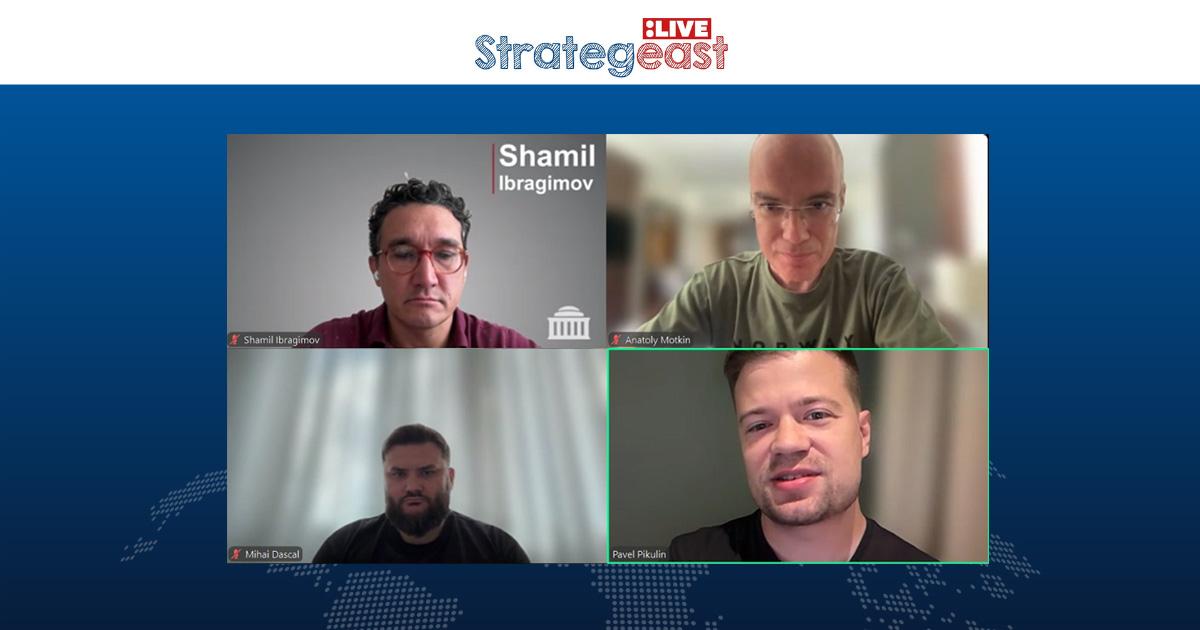
On September 10, StrategEast held a StrategEast.Live session, “DeepTech and AI in Eurasia – From Research to Global Impact,” bringing together leading experts to explore the region’s role in shaping the global innovation agenda.
The discussion was moderated by Anatoly Motkin, President of StrategEast, and featured distinguished speakers: Mihai Dascal, CEO of CorlabTech, President of We4Health, and CEO of Beby Medy; Shamil Ibragimov, Scholar in Residence at the MIT Kuo Sharper Center for Prosperity and Entrepreneurship, Sloan School of Management, MIT; and Pavlo Pikulin, Founder and CEO of Deus Robotics.
Speakers addressed critical questions, including how DeepTech and AI can transition from labs to markets, what role Eurasia can play in the global innovation ecosystem, and how governments, universities, accelerators, and the private sector can enable the growth of DeepTech companies.
Policy recommendations emphasized the importance of tech parks in shaping innovation trends, stronger collaboration between international financial institutions, development agencies, and businesses to support lab-to-market pilots, and greater government engagement to ensure sustainable growth. The conversation also highlighted the need to transform human resources into human capital through education, combine financial and human capital to unlock opportunities, and adapt to AI’s disruptive role as a general-purpose technology that will redefine productivity and prosperity across industries.
The session underscored that while building prototypes in traditional sectors may take months, DeepTech requires longer timelines and deeper involvement. Early-stage support from governments and development agencies is critical, while venture capital typically enters at later stages.
By exploring these opportunities and challenges, StrategEast continues to advance dialogue on how Eurasia can position itself as a key contributor to the global DeepTech and AI landscape.
StrategEast.Live is a series of online panel discussions launched by StrategEast in 2020 to continue the conversation on how technology can lead to an overall transformation in Eurasia. During these events, the esteemed guests put forward ideas that facilitate the further development of a knowledge-driven economy in the region.