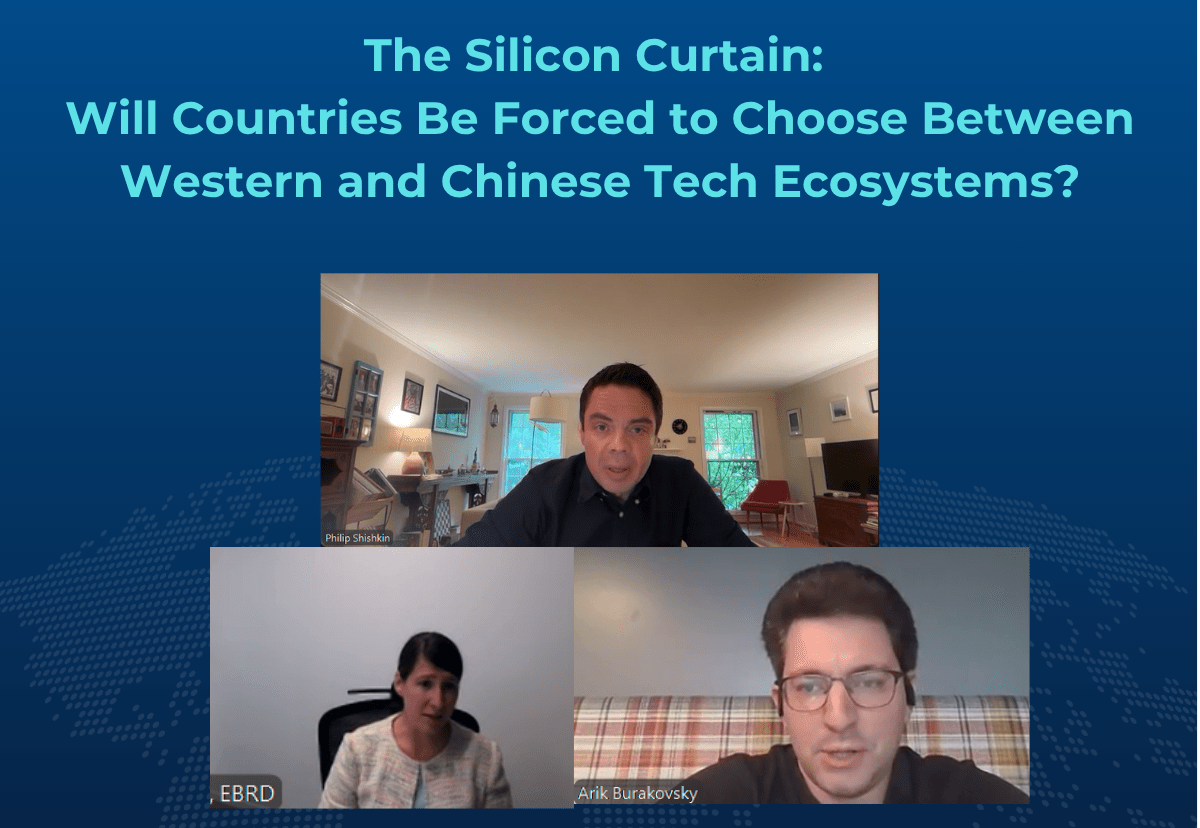
On June 23, StrategEast convened a Policy Dialogue session dedicated to the emerging phenomenon of the “Silicon Curtain,” exploring how rapid technological advances in the United States and China are reshaping global digital infrastructure and creating new geopolitical divisions in artificial intelligence and technology ecosystems.
The discussion brought together leading experts, including Zsoka Koczan, Lead Economist at the EBRD Office of the Chief Economist, and Arik Burakovsky, an independent expert on international political economy and Term Member of the Council on Foreign Relations. The session was moderated by Philip Shishkin, former Wall Street Journal foreign correspondent, author, and geopolitical analyst.
The panel examined three central themes: the emergence of competing Western and Chinese technology ecosystems and the increasing fragmentation of global digital infrastructure; the dependency mechanisms embedded in modern digital systems and the long-term “lock-in” effects they create; and the broader consequences of digital decoupling for economic development, innovation, and geopolitical alignment.
Speakers highlighted that countries across Eurasia and other emerging markets are increasingly faced with strategic decisions regarding technology providers and infrastructure partners. They emphasized that industrial policies, regulatory frameworks, and export restrictions are becoming key drivers of these choices, shaping the direction of long-term technological alignment.
It was noted that no country can achieve full technological sovereignty in today’s interconnected digital economy. He underscored that governments should instead focus on understanding their exposure to external dependencies, ensuring operational continuity during disruptions, and developing credible mitigation strategies to manage strategic risk.
The discussion also addressed the role of financing in shaping technological pathways, noting that while Chinese capital often provides competitive and accessible financing, it can also create structural dependency and long-term lock-in effects for recipient countries. Participants further debated the balance between digital sovereignty and access to frontier technologies, including the implications of relying on different AI ecosystems for critical applications.
Beyond economic considerations, the panel highlighted that technology choices increasingly carry political and governance implications, influencing institutional alignment and long-term strategic orientation of states.
As a next step, StrategEast will consolidate the insights from the discussion into a set of practical, action-oriented policy recommendations aimed at informing governments, development institutions, and private sector stakeholders navigating the evolving global technology landscape.