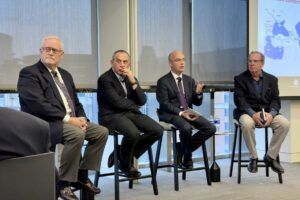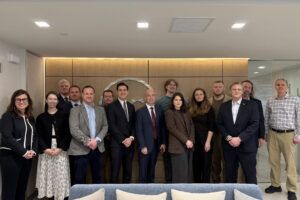
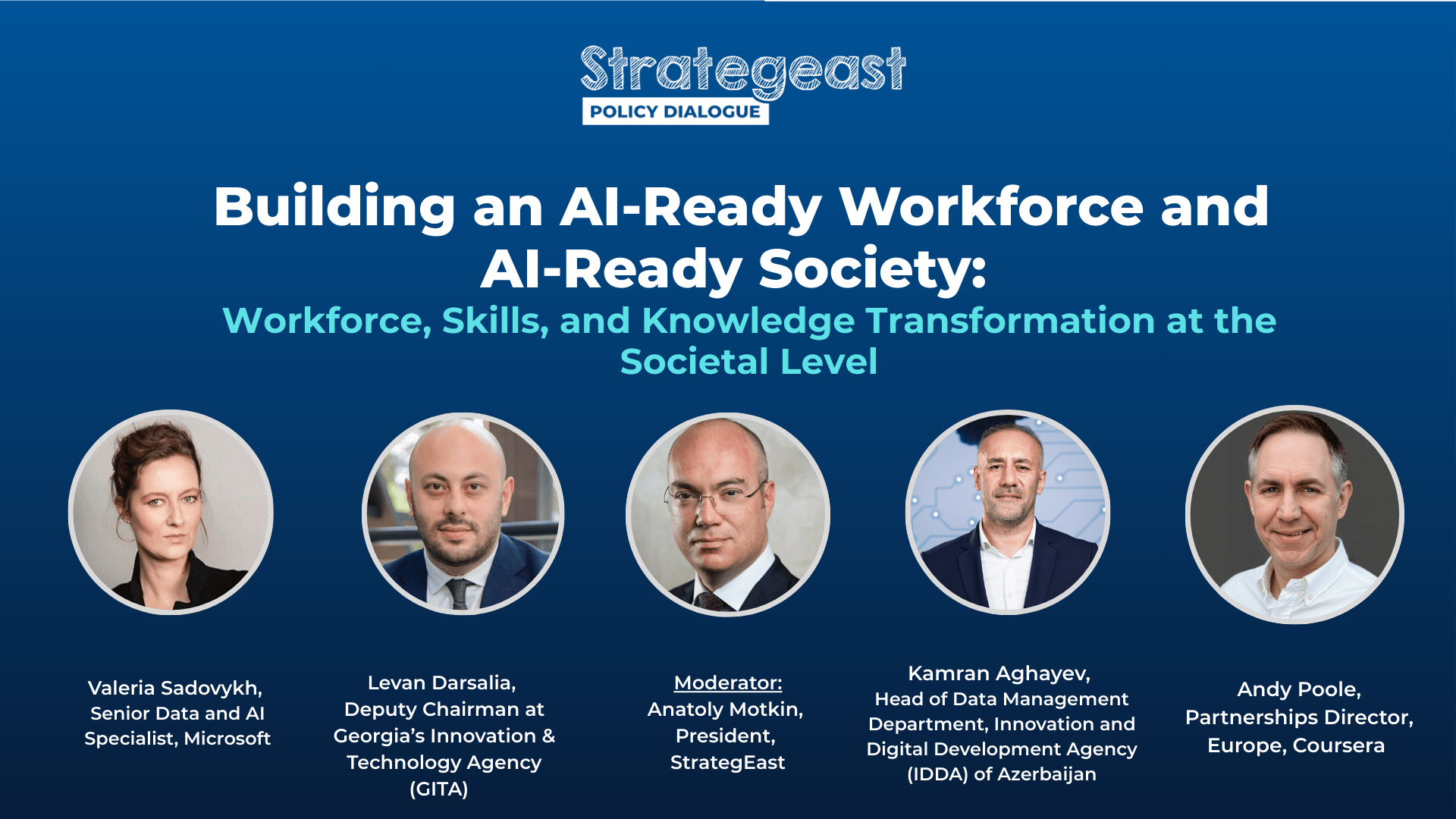
On February 17, StrategEast convened a high-level policy dialogue on “Workforce, Skills, and Knowledge Transformation at the Societal Level,” bringing together government leaders and global technology partners to examine how Eurasian countries can prepare their societies for rapid AI adoption. The session was moderated by Anatoly Motkin, President of StrategEast, and featured Valeria Sadovykh of Microsoft, Levan Darsalia of Georgia’s Innovation & Technology Agency (GITA), Kamran Aghayev of Azerbaijan’s Innovation and Digital Development Agency (IDDA), and Andy Poole of Coursera.
Speakers emphasized that while AI skills are increasingly embedded in job requirements, technical expertise alone will not ensure career resilience. Long-term competitiveness depends on a balanced skillset combining technical capabilities with critical thinking, adaptability, leadership, and communication. Participants warned of a growing “middle-level squeeze,” as automation eliminates entry-level roles while many graduates lack the cognitive and societal skills required for advancement.
Governments were urged to act as architects, integrators, and accelerators of AI transformation. Georgia is expanding large-scale IT training, developing incentives to attract AI data centers, and preparing to launch an AI Excellence Center in Kutaisi. Azerbaijan is strengthening data governance, providing GPU access through a national government cloud, and expanding AI training for civil servants and students, alongside university-startup collaboration on local AI solutions. Coursera highlighted national upskilling partnerships across the region, including initiatives that have reached tens of thousands of learners.
The discussion also stressed lifelong learning, micro-credentials, and responsible AI governance as essential pillars of societal trust. Participants agreed that AI transformation is not purely technological but systemic, requiring aligned investments in infrastructure, education reform, public-sector capacity, and social safeguards to ensure inclusive and sustainable growth.