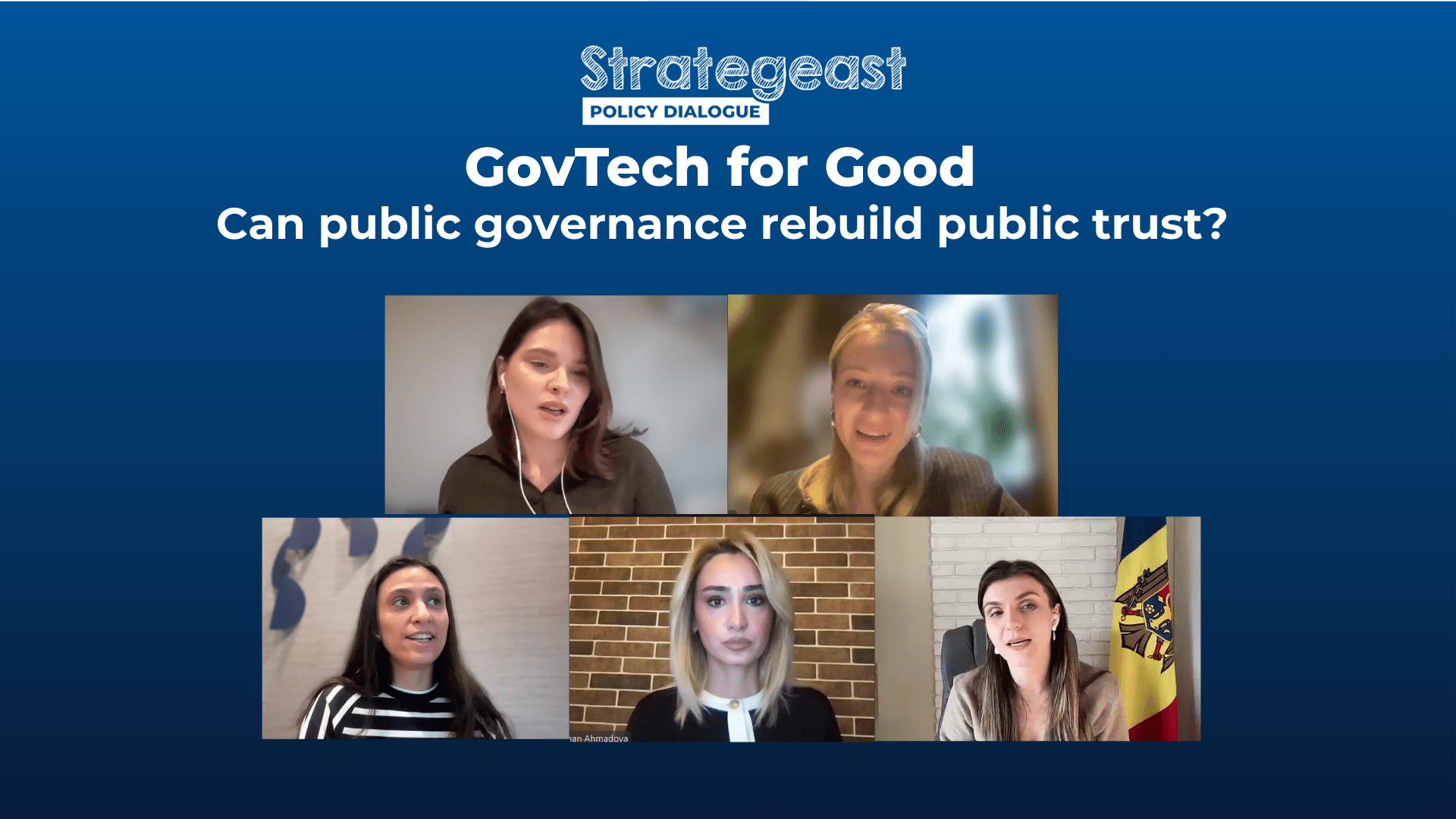
On January 13, StrategEast hosted a regular online session of its StrategEast Policy Dialogue series titled “GovTech for Good: Can Smart Governance Rebuild Public Trust?” The working session brought together policymakers, practitioners, and academic experts to examine how digital government solutions can strengthen transparency, accountability, and citizen trust across Eurasia.
The discussion was moderated by Hanna Myshko, Regional Director at StrategEast, and featured a distinguished panel of speakers: Nicoleta Colomeet from the e-Government Center of Moldova; Gulsanna Mamediieva, Tech & Public Policy Fellow and Adjunct Professor at Georgetown University’s McCourt School of Public Policy; Laman Ibrahimova, Advisor to the Director at the Innovations Center under Azerbaijan’s State Agency for Public Service and Social Innovations and Head of the ASAN AI Hub; and Kateryna Frolova, Head of Innovation Piloting at the Global Government Technology Centre Kyiv.
The session focused on how public trust is defined and measured in different national contexts and why it has become a central governance priority. Participants emphasized that trust is not built through technology alone, but through predictable, user-centric public services that consistently deliver results.
Speakers highlighted that predictability is fundamental to trust. Moldova’s experience shows that citizens overwhelmingly prefer digital services, with more than 95 percent choosing them over physical alternatives, while trust erosion is observed mainly in traditional institutions rather than digital government platforms. In Azerbaijan, trust is operationalized through strict service standards within the ASAN network, supported by real-time monitoring, feedback surveys, and guaranteed responses to citizen complaints. Ukraine’s approach centers on traceability and accountability, enabled by a strong digital public infrastructure that underpins platforms such as Diia and Prozorro.
From an academic perspective, the discussion underscored the link between service delivery, trust, and democratic participation. High-quality digital services can strengthen citizen engagement, but panelists also stressed the importance of preserving analog alternatives to ensure inclusivity and avoid alienating users who are not ready or able to transition fully to digital channels.
A key theme throughout the discussion was digital sovereignty. Panelists agreed that true sovereignty is not defined by where data is stored, but by a government’s ability to switch vendors, avoid lock-in, and retain control over citizen-facing services. Building internal capacity and embedding interoperability standards were identified as essential prerequisites for resilient digital governance.
The StrategEast Policy Dialogue series continues to serve as a premier platform for in-depth discussion on policies, innovations, and public–private partnerships shaping Eurasia’s digital transformation. By fostering open exchange among government leaders, technology experts, and international stakeholders, the series aims to support smarter governance models that can rebuild public trust and strengthen institutional resilience in the region.