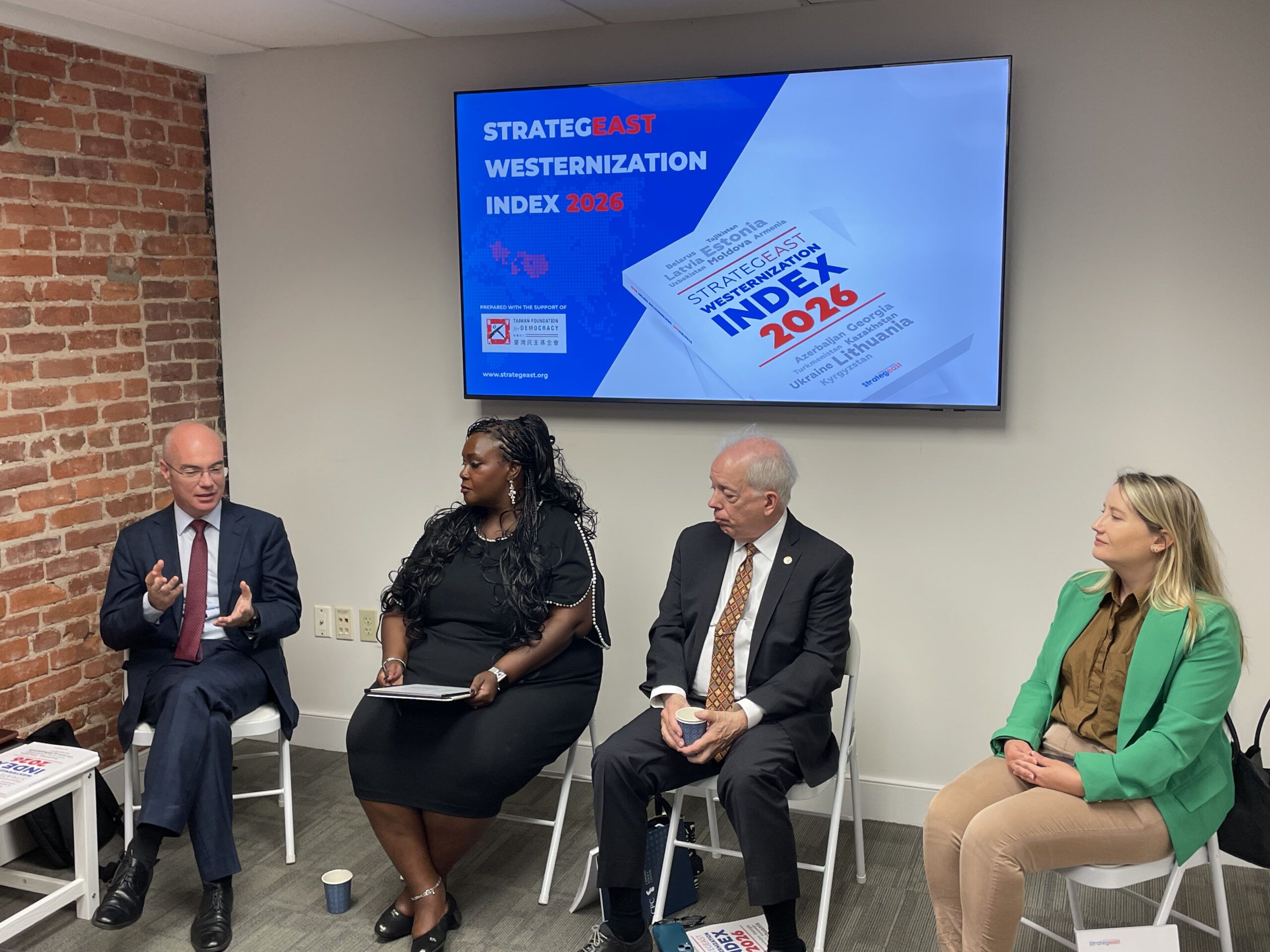
On May 13, StrategEast hosted the official launch of the Westernization Index 2026 in Washington, D.C., followed by a policy panel examining geopolitical, economic, and societal transformations across Eurasia.
The launch featured a panel discussion moderated by Anatoly Motkin, President of StrategEast with participation from Dr. Eric Rudenshiold, Senior Fellow, Caspian Policy Center; Danica R. Starks, Senior Fellow, Delphi Global Research Center and CEO, Morning Star Global Enterprises; and Olga Khakova, Senior Fellow, Atlantic Council. Experts discussed widening divergence across the region, the rise of “localization” models of engagement, and the implications for Western policy and investment strategies.
A central theme of the discussion was the evolving global attention landscape. Panelists noted that as Africa’s population is projected to reach roughly one-quarter of the world total within the next three decades, Eurasia faces a narrowing window to sustain strategic visibility and attract sustained Western engagement. This dynamic, they argued, increases pressure on the region to shift from geopolitical relevance alone toward clear commercial and investment value.
Speakers emphasized that digital connectivity, new energy and transport corridors, and infrastructure diversification are enabling parts of the region to reduce dependence on traditional gatekeepers and strengthen economic autonomy. At the same time, they cautioned that closing the gap between formal reforms and on-the-ground investor experience remains a critical challenge for long-term competitiveness. Panelists also agreed on the importance of stronger on-the-ground U.S. engagement in the region, emphasizing the need for a greater presence of U.S. government representatives and institutions to support sustained economic, strategic, and commercial cooperation.
The Index also highlights a broader shift from a binary “Westernization” narrative toward differentiated models of alignment, where countries pursue pragmatic cooperation with Western partners while maintaining locally adapted institutional and development pathways.
Since 2018, the Westernization Index has provided a unique comparative framework tracking transformation across Eurasia’s post-Soviet space, combining quantitative indicators with in-country expert analysis to capture both structural change and lived realities across the region.